Summary
In December 1988, the remains of an unidentified woman were found in a shallow grave on a remote farm in Daviess County, Missouri, which is located northeast of Kansas City, MO. Law enforcement agencies responded and began collecting evidence and investigating the case as a homicide. They estimated the woman's height to be 5'4" and weight to be 120 pounds. Investigators believed the woman was between the ages of 20 and 40 at the time of her death.
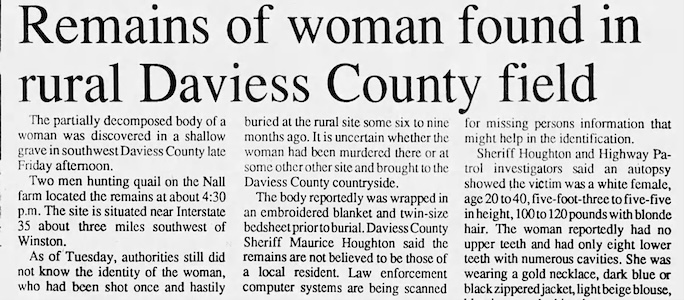
During the investigation, coins, paper currency, and a cigarette lighter were found near the woman's body. The woman was fully clothed, wearing a long sleeve zippered dark blue windbreaker, Lee denim jeans, and a light tan button-front shirt. Despite a lengthy investigation, the woman could not be identified and became known as Daviess County Jane Doe (1988). Details of the case were entered into the National Missing and Unidentified Persons System (NamUs) as UP17221.
In February 2025, investigators teamed with Othram to leverage identity inference, a process that enables investigators to identify individuals from DNA evidence, even when there is no known reference sample to initially compare against. Officials with the Kansas City Police Department, the Missouri State Highway Patrol Crime Laboratory, and the Daviess County Sheriff's Office worked together to submit forensic evidence to Othram's laboratory headquartered in The Woodlands, Texas.
At Othram, scientists reviewed details of the case, determining that advanced DNA testing could help to identify the woman. Othram scientists worked to develop a DNA extract from the provided skeletal remains, using Forensic-Grade Genome Sequencing® to build a comprehensive SNP profile for the woman. This SNP profile powered a forensic search led by Othram's in-house forensic genetic genealogy team, resulting in new investigative leads about the woman's identity.
Using this new information, a follow-up investigation was conducted leading investigators to potential relatives of the woman. Reference DNA samples were collected from a relative and compared to the DNA profile of the unidentified woman. This investigation led to the positive identification of the woman, who is now known to be Patricia Elaine (Oveson) Englund, born April 11, 1945.
Legislation sponsored by State Representative Tricia Byrnes of Wentzville enabled Othram's work in this case. In 2024, Rep. Byrnes secured $1.5 million in state funding in support of the Missouri State Highway Patrol’s efforts to identify unidentified human remains through forensic genetic genealogy.
This is the 27th publicly announced case in the State of Missouri where officials leveraged Othram’s identity inference pipeline. Explore other cases on Othram’s website.
Dan Miller
Director of Customer Service
Dan guides law enforcement agencies across the United States and internationally through every step of the forensic process—from crime scene to courtroom. He ensures investigators have the support and resources they need to navigate advanced DNA testing and maximize the impact of forensic evidence in their cases.