Summary
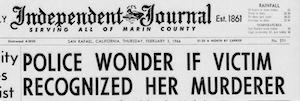
On February 2, 1966, Marjorie Rudolph, a 60-year-old wife of a prominent banker, was brutally murdered while alone in her home in San Rafael, California. The San Rafael Police Department responded and opened a homicide investigation. At the time, a possible suspect was identified, but he could not be definitively linked to the crime. At the Rudolph home, detectives found cigarette butts that were a different brand than the ones smoked by the people who were generally in the home, leading investigators to believe they belonged to the killer.
Despite an exhaustive investigation, which included collecting and saving the cigarette butts as evidence, the primary suspect could not be confirmed as the killer and the case went cold.
In 2025, investigators teamed with Othram to leverage identity inference, a process that enables investigators to identify individuals from DNA evidence, even when there is no known reference sample to initially compare against. Officials with the San Rafael Police Department and the Sacramento County District Attorney's Office worked together to submit the cigarette butts to Othram's laboratory headquartered in The Woodlands, Texas.
At Othram, scientists reviewed details of the case, determining that advanced DNA testing could help to identify the suspect. Othram scientists worked to develop a DNA extract from the provided evidence, using Forensic-Grade Genome Sequencing® to build a comprehensive SNP DNA profile for the suspect. Law enforcement took the lead in the forensic genetic genealogy step using the DNA profile developed by Othram. 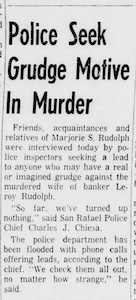
A follow-up investigation was conducted leading investigators to potential relatives of the suspect. KinSNP® Rapid Relationship Testing was used to assist in the comparison of a reference DNA profile to the DNA profile developed for the suspect. This investigation led to the positive identification of the suspect, who is now known to be Laurel James Switzer, the man police originally suspected to be Marjorie Rudolph's killer.
At the time of the murder, Switzer was a 42-year-old former police officer who was unemployed. His wife worked at the bank that was run by Marjorie Rudolph's husband. The two families knew each other, and police learned that Switzer had a dispute with Rudolph and her husband prior to Rudolph's murder. However, officials do not know exactly why Switzer killed Marjorie Rudolph. Switzer left the area the next day and went to South Lake Tahoe, a city in northern California. He committed suicide just days after the murder.
Funding for Othram's casework cost was provided by a grant from Season of Justice. Season of Justice is a nonprofit organization dedicated to providing funding to investigative agencies and families to help solve cold cases.
This case is a reminder that every piece of preserved evidence has the potential to unlock long-awaited answers. If you would like to support efforts to solve more cases like this, consider contributing your DNA data to the DNASolves database which aids law enforcement in identifying suspects and giving families the answers they deserve.
This is the 78th publicly announced case in the State of California where officials leveraged Othram’s identity inference pipeline. Explore other cases on Othram’s website.

Dan Miller
Director of Customer Service
Dan guides law enforcement agencies across the United States and internationally through every step of the forensic process—from crime scene to courtroom. He ensures investigators have the support and resources they need to navigate advanced DNA testing and maximize the impact of forensic evidence in their cases.